
Alberta Orders Edmonton to Roll Back Its Infill Rules: The Full Timeline, the Federal Deal and What Happens Next

Edmonton Real Estate News
Alberta Orders Edmonton to Roll Back Its Infill Rules: The Full Timeline, the Federal Deal and What Happens Next
The Direct Answer
On Thursday, October 8, 2026, Premier Danielle Smith and Municipal Affairs Minister Dan Williams announced that the Province of Alberta is directing the City of Edmonton to repeal its current infill bylaws. Edmonton has three months to return to the housing type, density, and height rules that were in place before 2024, and to restore the minimum on-site parking requirements that were in place before 2020. After that, the city must carry out an 18-month review of its land-use bylaws, with public consultation and input from industry. The 8-unit "as of right" rules at the centre of this were part of Edmonton's 2024 zoning overhaul, and they were supported by federal funding. This post walks through how we got here, what Ottawa offered, and exactly what the province has ordered. This story is only one day old, so details may change.
The Timeline at a Glance
| Date | What happened |
| October 2023 | After six days of public hearings, Edmonton council approves a full rewrite of its zoning bylaw by an 11-2 vote. |
| January 1, 2024 | The new Zoning Bylaw 20001 takes effect. The number of residential zones drops from 16 to six, and the default "RS" zone allows up to eight units on a standard lot. |
| February 21, 2024 | Ottawa announces more than $175 million through the Housing Accelerator Fund to help Edmonton fast-track more than 5,200 homes over three years. |
| 2024 | Alberta gives itself new powers to rescind municipal bylaws it considers at odds with provincial policy, and to call a vote on removing a local elected official. |
| July 2025 | Council votes 6-5 to keep the eight-unit cap and agrees to a consultation on whether to reduce it. |
| 2025 municipal election | Voters return a council that includes pro-infill members, according to one housing advocacy group. |
| February 17, 2026 | Council defeats, by 8-4, a motion to cut the mid-block cap from eight units to six. |
| April 27, 2026 | Council approves a lower height limit for small-scale infill, from 10.5 metres to 9.5 metres, effective August 1, 2026. |
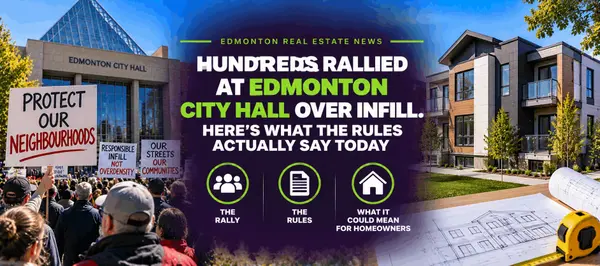
| October 4, 2026 | Hundreds rally at Churchill Square outside City Hall, organized by Edmonton Neighbourhoods United. |
| October 8, 2026 | Alberta announces the directive: roll back within three months, then an 18-month review. |
What the 2024 Zoning Overhaul Actually Changed
Before 2024, how many homes you could build on a lot depended on the zone, and reporting describes the new bylaw as raising the ceiling from six units to eight. The new bylaw replaced 16 residential zones with six. In its default residential zone, called RS, an owner or builder can build up to eight units on a standard lot, up to three storeys, without applying for a rezoning or going to a public hearing, as long as the project meets the zone's rules. That is what "as of right" means. Reporting also describes the new rules as removing mandatory minimum off-street parking requirements. In plain terms, a project that fits the rules gets approved on the strength of the rules, without a discretionary process.
Council has adjusted the framework since then. It kept the eight-unit cap in July 2025 and again in February 2026, and in April 2026 it lowered the height limit by a metre. City staff reported that roughly 80% of the infill built in 2024 and 2025 already came in at 9.5 metres or under, which is one reason community leagues called the change welcome but modest.
What Ottawa Offered: The Housing Accelerator Fund
The federal Housing Accelerator Fund (HAF) was the main outside incentive. On February 21, 2024, then-Prime Minister Justin Trudeau announced, in Edmonton, an agreement worth more than $175 million to help the city fast-track more than 5,200 homes over three years and support the construction of more than 22,000 homes over the next decade. The federal news release lists what Edmonton committed to in return:
- Eight units as of right and up to three storeys city-wide, which the release said Edmonton had already begun permitting.
- More homes near transit.
- City-owned land used to build hundreds of new homes.
- Secondary suites promoted and supported.
- Faster approvals through digitization, automation and streamlined zoning processes, plus more resources for builders.
- Support for non-profit and affordable housing, including pre-development funding and shorter approval timelines.
- Phasing out the tax premium on properties with four or more units, reduced by three per cent a year over five years.
Housing Minister Sean Fraser described the deal as a way to encourage building near transit and streamline permitting, and then-Mayor Amarjeet Sohi said it would help the city boost building opportunities and streamline processes. It is worth being clear about what the money did and did not do. Edmonton had already chosen to legalize more "missing middle" housing and to permit density more broadly. The federal agreement rewarded and reinforced that direction. It did not create the eight-unit rule on its own. I did not find any reporting yet on whether the provincial order affects Edmonton's federal funding or the commitments tied to it, and that is a question worth watching.
What Alberta Has Ordered, in Detail
| Requirement | Timing | What it means |
| Return to the housing type, density, and height parameters in place before 2024 | Three months from October 8, 2026 | Ends the as-of-right eight-unit approvals in residential areas and the three-storey, city-wide framework. |
| Restore minimum on-site parking requirements in place before 2020 | Three months from October 8, 2026 | Brings back required parking for new projects. |
| Review the land-use bylaw, consult the public and work with industry | 18 months | Develops a new approach to high-density infill. The rollback stays in place while the review is under way. |
Three months from October 8 works out to about January 8, 2027. Reports differ slightly on whether the 18 months start on October 8 or after the three-month rollback, so I would treat the end date of the review as not yet confirmed.
The legal basis. The province cites Section 694 of the Municipal Government Act, which allows it to direct a municipality to amend its land-use bylaw. In 2024, Alberta also gave itself power to rescind municipal bylaws it considers at odds with provincial policy, and to call a vote on removing a local elected official it considers unwilling or unable to do the job. Mayor Andrew Knack has said that council members could be removed from office if the city does not follow the order. The province has not publicly laid out a step-by-step enforcement process, and Minister Williams described the move as starting a "conversation" rather than an ultimatum, while the premier's office framed the three-month deadline as binding.
The reasons given. Premier Smith said current policies are too permissive and harm homeowners through lower property values and parking problems, and said the city lacks buy-in from existing residents. In her words, "When growth outpaces the infrastructure and services that support a neighbourhood, residents feel it." Minister Williams said the province has seen "extreme examples" dividing neighbourhoods and wants a pause.
Calgary. The directive treats the two cities differently. Calgary, which had already started repealing some of its zoning changes, has been told to maintain its current rules, and its broader review is planned for completion in 2027.
How People Are Reacting
Reaction is split. Here is where each side stands, starting with those who oppose the order and want to keep the current rules.
Opposed to the order, or supportive of the current rules
- Mayor Andrew Knack called the decision uninformed and insulting. He said it would raise property taxes, reduce affordability, and push growth to the edge of the city. He said a conversation held after a decision is made is not a real conversation, and he is considering options to fight the order.
- Jacob Dawang of Grow Together Edmonton, a pro-housing group, called the move undemocratic, pointing out that voters returned pro-infill councillors in the 2025 election.
- Damian Collins, a housing scholar, warned that bringing back mandatory parking requirements could slow development and add costs.
Critics of the current infill rules, and supporters of the order
- Jaclyn Soroka, co-founder of Edmonton Neighbourhoods United, appeared alongside the premier at the announcement. According to reporting, she thanked Smith for stepping in and for listening when she felt city councillors had not, and described her goal as thoughtful city planning. Her group organized the October 4 rally.
- Dallas Moravec, chair of Edmonton Neighbourhoods United and an Edmonton real estate agent, organized the October 4 rally after more than a year of pushing for stricter infill limits without what he saw as a meaningful response from the city. He has said the group is not against infill, but wants it done responsibly, with particular concern about multiplexes and large-scale projects. I did not find a direct statement from him on the order itself.
- Councillor Karen Principe voted against the 2024 zoning overhaul and later proposed cutting the mid-block cap from eight units to six, citing parking and waste management capacity. That motion was defeated 8-4 in February 2026. She has also asked city staff to report on how multi-unit infill may be affecting nearby property values. I did not find a statement from her on the provincial order.
- Jesse Watson, who ran for council in Ward Anirniq in the 2025 election, has argued that the new zoning bylaw eroded neighbourhood character and context. His platform called for slowing infill with stricter rules, including bringing back parking minimums and requiring more landscaping to protect tree canopy. These are his positions from the 2025 campaign, not a reaction to the October 8 order.
Others
- Builders and the federal government: No reaction from either had been reported at the time of writing.
What Is Still Unclear
- How projects that already have permits will be treated, compared with new applications.
- What happens to applications now in progress under the current rules.
- Whether the federal funding agreement is affected.
- Whether the city will comply, challenge the order, or negotiate changes. Mayor Knack says he is considering his options.
What It Could Mean for East YEG Homeowners, Buyers and Sellers
East YEG (East Edmonton) is made up largely of mature neighbourhoods, and communities like Ottewell, with 1950s and 1960s bungalows on wide lots, are exactly the kind of streets this debate is about. A few honest takeaways:
- Redevelopment potential may be worth less, or at least less certain. If the eight-unit rule goes away, the value a builder could see in a large mid-block lot could change. How much, and when, depends on what the new rules look like after the review, so I would not put a number on it.
- Uncertainty is the main near-term effect. Builders and buyers who were planning around the current rules now face a possible change within about three months. Expect some to pause until the picture is clearer.
- Established homeowners who dislike infill may see this as a win. Those who bought hoping to redevelop or sell to a builder may see it differently. Both views are real, and I would not assume the market treats everyone the same way.
- If you are buying or selling, ask what the zoning is now and how a change could affect the specific lot. Your lawyer and your realtor can help you check before you sign.
This order follows the October 4 rally at City Hall, and it is part of the same debate behind the lodging house rule changes council made last month. It is likely to keep moving. This is general information, not legal advice, and I will update as the story develops.
Thinking About Selling in East YEG?
What Would It Take to Get Top Dollar for Your Home?
Between negotiation trends, price reductions, and how fast homes are actually moving right now, the numbers above only tell part of the story. I'll give you a straight answer on what your specific home is worth today, and what it would take to maximize your sale price in this market.
Get Your Free Home Valuation Book a Free Strategy CallFrequently Asked Questions
What did Alberta order Edmonton to do on October 8, 2026?
Alberta directed Edmonton to repeal its infill bylaws and return to the housing type, density, and height rules in place before 2024, and to restore the minimum on-site parking requirements in place before 2020. The city has three months to comply, followed by an 18-month review of its land-use bylaws with public consultation.
What federal funding was tied to Edmonton's infill rules?
In February 2024, Ottawa announced more than $175 million through the Housing Accelerator Fund to help Edmonton fast-track more than 5,200 homes over three years. Edmonton committed to measures including allowing up to eight units as of right and up to three storeys city-wide.
Can Alberta force Edmonton to change its zoning bylaw?
The province says it can under Section 694 of the Municipal Government Act, which allows it to direct a municipality to amend its land-use bylaw. In 2024, Alberta also gave itself power to rescind municipal bylaws. Mayor Andrew Knack has said council members could be removed if the city does not comply, and he is considering options to fight the order.
Jason Beattie
REALTOR® | eXp Realty | BT Group
780-791-9633 | Jason.Beattie@eXpRealty.com
Book a Free Strategy Call
Categories
- All Blogs (96)
- downsizing (16)
- East YEG (49)
- Eco-friendly Homes (1)
- Edmonton Bylaws (5)
- Events & Community News (36)
- First Time Home Buyer (36)
- Gardening & Landscaping (1)
- Home Buying Tips (50)
- Home Insurance (5)
- Home Selling Tips (39)
- How to (14)
- increase home value (15)
- Interior Design (2)
- Local Market Trends (59)
- market Influences (69)
- Market Update (48)
- Migration (4)
- Mortgage Info (4)
- Moving & Relocation (63)
- Neighborhood Profiles (50)
- Real Estate FAQs (81)
- Real Estate Investment (8)
- Real Estate Laws & Regulations (4)
- Technology in Real Estate (2)
Recent Posts







"With 25+ years in Edmonton real estate, I track weekly sales activity across all 13 East YEG neighbourhoods so buyers and sellers get real numbers, not guesswork. If you're weighing a move in East Edmonton, I'm happy to walk you through what the data means for your street."