
Alberta's Plan to Double Oil Production: What the Oil Sands Growth Program Means for Edmonton Homeowners
Alberta News
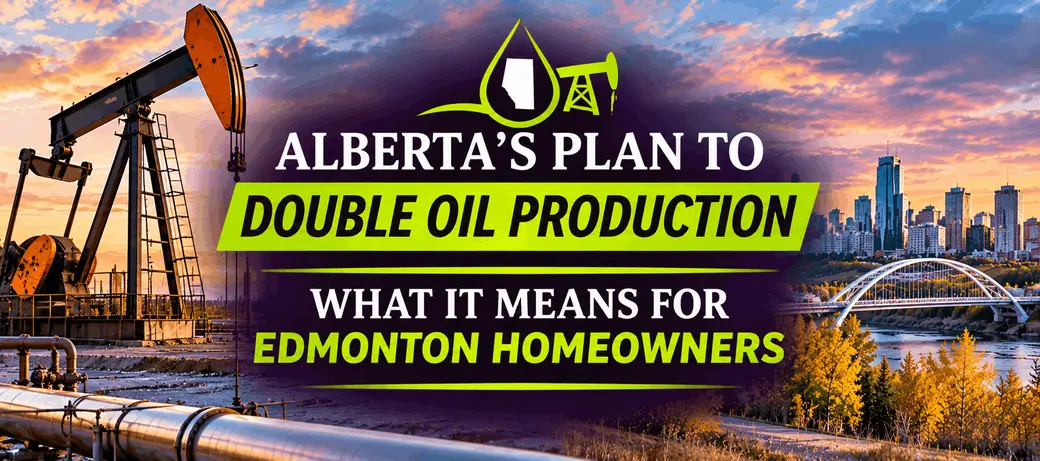
Alberta's Plan to Double Oil Production: What the Oil Sands Growth Program Means for Edmonton Homeowners
The Short Version
On November 13, 2026, Premier Danielle Smith, Energy Minister Brian Jean and Finance Minister Jason Nixon announced the Oil Sands Growth Program. It gives new oil sands production a guaranteed 10-year royalty schedule that starts at 2%. The goal is to attract investment, fill new pipelines and help Alberta double its oil production to about 8 million barrels a day. Smith has said she wants to reach that by about 2035. The program is targeted to start in spring 2027, and the province says it will bring tens of thousands of jobs. Economists and industry insiders are divided on whether it will work. The announcement has no housing numbers, so what it means for Edmonton homeowners is a question of what to watch, not a forecast.
What the Program Does
- The royalty: eligible projects pay 2% of gross revenue for the first five years, then the rate rises one percentage point a year until it reaches 6% in years 9 and 10. By simple arithmetic, years 6 to 8 would be 3%, 4% and 5%.
- A safety net: according to The Hub, companies can pay the normal royalty instead whenever it would be lower, which protects them if oil prices fall.
- Who qualifies: new greenfield or brownfield projects adding at least 5,000 barrels a day. They can use existing infrastructure but cannot sit inside the boundary of a previously approved project.
- After 10 years: projects return to the regular royalty system.
- Timing: the program is targeted to launch in spring 2027, and the government will review it by the end of 2029.
- Conditions: projects still need regulatory approvals, environmental compliance and Indigenous consultation where required.
Where Production Is Today
Smith said in March 2026 that Alberta was producing close to 5 million barrels a day, up from about 3.7 million in 2023. That is her own figure, not a regulator's. If it is right, reaching 8 million would mean adding about 3 million barrels a day, which is roughly 60% more than today (my arithmetic). The province's pitch is that this needs new pipeline capacity and new investment to fill it.
The Government's Numbers
The province says doubling production could add about $205 billion in cumulative government revenue by 2040 and more than $1.3 trillion by 2060. For context, oil sands royalties were $17.2 billion in 2024-25, according to The Hub. The Hub reports the province has not released the assumptions behind the projection.
What the Critics and Backers Say
| Who | View |
|---|---|
| Suncor CEO Rich Kruger | Welcomed a "globally competitive" regime and said it would make a material difference. |
| Richard Masson, former Alberta oil sands policy director | The average gross royalty over the past decade was about 5%, versus about 3.4% on average under the new schedule. He calls it a signal of support, not a big gift. |
| Lennie Kaplan, former Treasury Board and Finance official | His early modelling at $70 oil estimates $116.9 billion in forgone revenue or costs by 2040 against $41.3 billion in extra revenue, with the net benefit turning positive only by about 2060. These are his estimates, not the government's. |
| Grant Sprague, former deputy energy minister | Questions whether royalties are the real obstacle and points to federal regulatory uncertainty. |
| Pembina Institute | Says the program leaves potential provincial revenue on the table for an already profitable sector. |
What Has to Go Right
- Pipelines: new capacity has to be approved and built, and producers have to commit to using it. Proposals such as a West Coast pipeline and a Hardisty-to-Sarnia line are still proposals.
- Carbon capture and Ottawa: the program is tied to a non-binding agreement between the province, the federal government and five oil sands companies. Company CEOs have said a November 15 deadline for the remaining agreements, including the Pathways carbon capture project, will likely be missed.
- Company decisions: investment choices rest with corporate boards and depend on oil prices.
- Diluent: The Hub reports that more production would need a lot more imported condensate to move it.
What It Could Mean for Edmonton Homeowners
The announcement itself has no housing figures, so nobody can honestly say what it does to Edmonton prices. Here is what to watch:
- Timing: the program starts in spring 2027 at the earliest, and large projects take years to plan and build. Any effect on hiring and migration would come slowly.
- Migration: Alberta is still growing, but Edmonton's migration is forecast to slow. We covered that in Is Alberta's Population Growth Still Supporting Edmonton Home Demand?
- Local market: Edmonton is in a more balanced market today, as we explained in Edmonton Realtors Are Talking About a Balanced Market. Interest rates, local supply and your neighbourhood matter more than a royalty schedule.
- Whether it happens: if the pipelines, agreements and company decisions fall into place, the effect could be positive. If they do not, the effect could be small.
If you are thinking about selling, the best starting point is not the oil price. It is your home's current value and what has sold near you recently. This is general information, not investment or financial advice.
Thinking About Selling in East YEG?
What Would It Take to Get Top Dollar for Your Home?
Between negotiation trends, price reductions, and how fast homes are actually moving right now, the numbers above only tell part of the story. I'll give you a straight answer on what your specific home is worth today, and what it would take to maximize your sale price in this market.
Get Your Free Home ValuationBook a Free Strategy CallFrequently Asked Questions
What is the Oil Sands Growth Program?
It is a 10-year royalty framework the Alberta government announced on November 13, 2026 for new oil sands production. Eligible projects pay a 2% royalty for the first five years, rising by one percentage point a year to 6% in years 9 and 10. It is targeted to launch in spring 2027.
Will doubling oil production raise Edmonton home prices?
There is no guarantee. The announcement includes no housing figures. More investment and jobs can support demand for homes over time, but projects take years to build and depend on oil prices, pipelines and company decisions. Local sales, interest rates and migration matter more in the short term.
Does this change anything for sellers in East Edmonton today?
Not directly. The program is not expected to start until spring 2027, so current pricing and buyer demand still depend on local conditions, which is why a current valuation of your home is the best starting point.
Jason Beattie
REALTOR® | eXp Realty | BT Group
780-791-9633 | Jason.Beattie@eXpRealty.com
Book a Free Strategy CallCategories
- All Blogs (129)
- downsizing (17)
- East YEG (74)
- Eco-friendly Homes (1)
- Edmonton Bylaws (6)
- Events & Community News (44)
- First Time Home Buyer (41)
- Gardening & Landscaping (1)
- Home Buying Tips (56)
- Home Insurance (5)
- Home Selling Tips (52)
- How to (16)
- increase home value (16)
- Interior Design (2)
- Local Market Trends (81)
- market Influences (82)
- Market Update (58)
- Migration (7)
- Mortgage Info (8)
- Moving & Relocation (74)
- Neighborhood Profiles (57)
- Real Estate FAQs (94)
- Real Estate Investment (12)
- Real Estate Laws & Regulations (7)
- Technology in Real Estate (2)
Recent Posts







"With 25+ years in Edmonton real estate, I track weekly sales activity across all 17 East YEG neighbourhoods so buyers and sellers get real numbers, not guesswork. If you're weighing a move in East Edmonton, I'm happy to walk you through what the data means for your street."