
Is Alberta's Population Growth Still Supporting Edmonton Home Demand?

Alberta Real Estate News
Is Alberta's Population Growth Still Supporting Edmonton Home Demand?
The Direct Answer
Mostly yes, but the support is steadier than it used to be, not stronger. Alberta is still adding people faster than any other province, and it has been drawing residents from the rest of Canada for 20 straight quarters. At the same time, growth has slowed, and the City of Edmonton's own forecast shows migration into the Edmonton region dropping sharply this year. Population growth is still a floor under local demand, but it is no longer pushing buyers into a rush.
What the Latest Numbers Say
According to ATB Financial's summary of Statistics Canada's September 23, 2026 release, Alberta's population was 5,101,050 as of July 1, 2026, up 1.5% over the year. That was the highest growth of any province, while Canada as a whole grew just 0.5%, its smallest annual gain in more than a century by that count. Alberta added 5,893 people from other provinces in the latest quarter, the largest gain of any province, and births exceeded deaths by about 19,300 over the year, the second-largest natural increase in the country. Alberta's population of non-permanent residents, such as temporary workers and students, also fell by less than in other provinces. The province's own population page says the same thing for the second quarter of 2026: Alberta had the strongest net inflow from other provinces.
Where Edmonton Is Different
The province-wide picture is stronger than the local one. The City of Edmonton's spring 2026 economic outlook, finalized on March 31, 2026, projects the Edmonton region growing about 1.5% in 2026, compared with 3.1% in 2025, with net migration of roughly 19,500 people versus about 44,300 the year before. The City's table shows net migration at 74,900 in 2024. Those are forecasts and estimates prepared by the City and Stokes Economics, not Statistics Canada counts. Royal LePage's third-quarter report points the same direction. Tom Shearer of Royal LePage Noralta said summer began with solid momentum that softened later, citing slower in-migration, regional flooding and weaker buyer urgency. The Edmonton-region aggregate price was $479,500, up 0.7% from a year earlier and down 0.6% from the second quarter.
What It Means for East YEG Buyers and Sellers
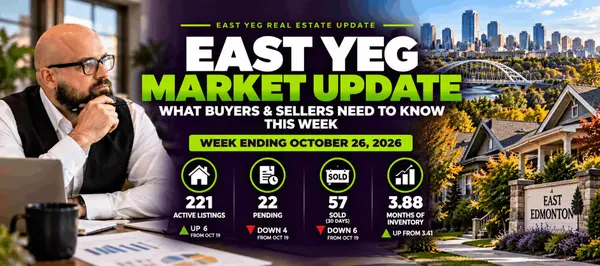
In East YEG (East Edmonton), the market is behaving like one that has enough demand to keep moving but not enough to absorb every new listing quickly. As of October 26, 2026, East YEG had 221 active listings and about 3.88 months of inventory, up from 3.41 a week earlier, and 40.3% of active listings had been price-reduced from their original list price. Our weekly East YEG market update has the full breakdown. For buyers, that means more choice and more room to negotiate than a year ago. For sellers, it means pricing correctly from day one matters more than hoping a wave of newcomers will bail out an optimistic price. A steady population keeps homes selling, but it does not guarantee every home sells fast.
BT Group East YEG Market Research is prepared by Jason Beattie, REALTOR® with eXp Realty, using current REALTORS® Association of Edmonton MLS® market activity across the East YEG neighbourhoods tracked in this report. Short-term neighbourhood statistics can fluctuate when relatively few properties sell; individual property values should not be inferred from neighbourhood averages alone.
What to Watch Next
Three things will decide whether growth keeps supporting demand. First, whether interprovincial migration stays strong as the number of temporary residents shrinks. Second, whether Edmonton's actual migration numbers land closer to the City's forecast or above it, since the next Statistics Canada estimates will show that. Third, how federal and provincial immigration policy changes feed into household formation, which I walk through in Will Alberta's Immigration Changes Affect Edmonton Home Prices? This is general information, not a forecast for any specific home, so talk with me about your own situation before making a decision.
Thinking About Selling in East YEG?
What Would It Take to Get Top Dollar for Your Home?
Between negotiation trends, price reductions, and how fast homes are actually moving right now, the numbers above only tell part of the story. I'll give you a straight answer on what your specific home is worth today, and what it would take to maximize your sale price in this market.
Get Your Free Home Valuation Book a Free Strategy CallFrequently Asked Questions
Is Alberta still the fastest-growing province in Canada?
Yes. Alberta's population grew 1.5% to 5,101,050 as of July 1, 2026, the highest growth of any province, compared with 0.5% for Canada overall, according to ATB Financial's summary of the Statistics Canada release of September 23, 2026.
Is migration to Edmonton slowing down?
The City of Edmonton's spring 2026 forecast projects the Edmonton region growing about 1.5% in 2026, down from 3.1% in 2025, with net migration of roughly 19,500 people versus about 44,300 in 2025. These are forecasts rather than Statistics Canada counts. Royal LePage also cited slower in-migration in its third-quarter 2026 report.
Does population growth mean Edmonton home prices will rise?
Not automatically. Population growth supports demand, but prices also depend on supply, interest rates and buyer urgency. Royal LePage reported the Edmonton-region aggregate price at $479,500 in Q3 2026, up 0.7% from a year earlier and down 0.6% from the second quarter.
Jason Beattie
REALTOR® | eXp Realty | BT Group
780-791-9633 | Jason.Beattie@eXpRealty.com
Book a Free Strategy CallCategories
- All Blogs (112)
- downsizing (17)
- East YEG (62)
- Eco-friendly Homes (1)
- Edmonton Bylaws (6)
- Events & Community News (43)
- First Time Home Buyer (40)
- Gardening & Landscaping (1)
- Home Buying Tips (55)
- Home Insurance (5)
- Home Selling Tips (46)
- How to (16)
- increase home value (16)
- Interior Design (2)
- Local Market Trends (70)
- market Influences (80)
- Market Update (53)
- Migration (7)
- Mortgage Info (8)
- Moving & Relocation (74)
- Neighborhood Profiles (54)
- Real Estate FAQs (93)
- Real Estate Investment (11)
- Real Estate Laws & Regulations (5)
- Technology in Real Estate (2)
Recent Posts








"With 25+ years in Edmonton real estate, I track weekly sales activity across all 17 East YEG neighbourhoods so buyers and sellers get real numbers, not guesswork. If you're weighing a move in East Edmonton, I'm happy to walk you through what the data means for your street."