
Forest Heights, Edmonton: A Complete Neighbourhood Guide for Buyers & Sellers
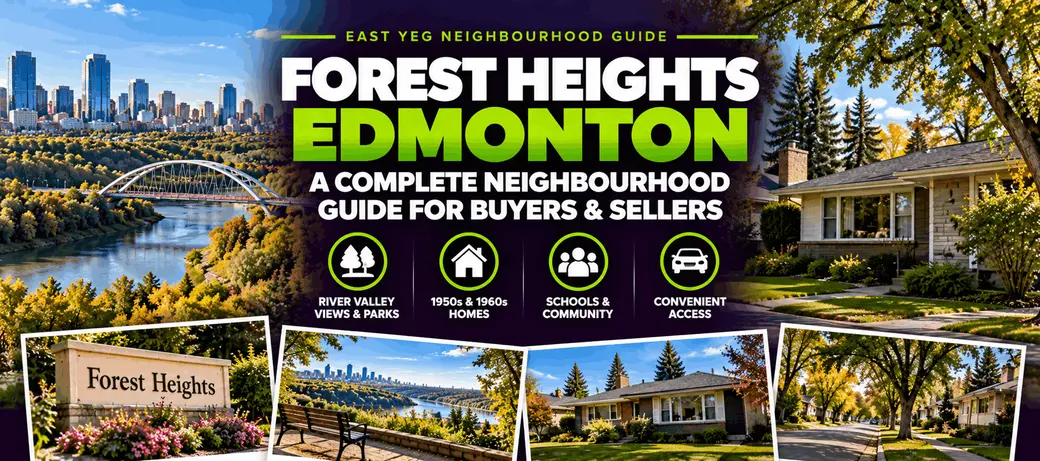
East YEG Neighbourhood Profile
Forest Heights, Edmonton (East YEG)
A Subdivision That Waited Decades to Be Built
Forest Heights, in East YEG (East Edmonton), has an unusual start. According to the City of Edmonton's neighbourhood profile, it was first developed in 1911 by Windsor Realty, and the City assumes the company's owner, James H. McKinley, an alderman from 1909 to 1911, chose the name. Taproot Edmonton describes lots being advertised for sale on November 8, 1911, with a $50 deposit. The area officially became part of Edmonton in 1913, but then growth slowed and the First World War began in 1914, and the land stayed in agricultural use into the 1940s.
Housing demand surged after the Second World War, and most of Forest Heights was built in the 1950s. The sources differ slightly on timing, with the City saying most development came in the 1950s and Taproot saying building stayed frozen until the second half of that decade, so it is safest to say the 1950s overall. The neighbourhood also holds a piece of older history: Edmonton's Jewish cemetery, founded by Abraham Cristall in 1907, was already there in 1911 and still operates today.
Housing Stock & Architecture
This is a postwar neighbourhood. Census figures cited on Wikipedia show that about half of the homes (51%) were built between the end of the Second World War and 1960, another 25% in the 1960s and 10% in the 1970s, with construction substantially complete by 1980. The City describes the dominant building on the interior streets as the single-detached house, laid out on a mix of grid and modified-grid streets, with commercial and higher density buildings along the roads that bound the neighbourhood.
In the 2005 municipal census, about 76% of homes were single-family, about 12% were low-rise apartments or condominiums and about 11% were duplexes or other multi-unit buildings, and about 61% were owner-occupied. That census is more than 20 years old, so treat it as a sign of the neighbourhood's character rather than a current statistic. For buyers, the practical picture is mostly 1950s and 1960s bungalows, with the age of the home, the lot and how it has been updated mattering as much as the address.
The River Valley Setting
The North Saskatchewan River valley is the defining feature here. The City describes Forest Heights as sitting on the south bank of the valley where the river bends from north to east, with valley views possible on the west, north and east sides of the neighbourhood. The City's park listing includes Forest Heights Park at 10104 84 Street NW, and visitor reviews describe a spot with downtown views and trails that lead down into the valley. I could not confirm facilities there from an official source, so check before you go.
Schools & Community
According to Wikipedia, Forest Heights Elementary School and McNally High School (Edmonton Public Schools), St. Bride Catholic School (Edmonton Catholic) and École Michaëlle-Jean (Conseil Scolaire Centre-Nord) serve the neighbourhood, so confirm current school boundaries with the school boards before you buy. The Forest/Terrace Heights Community League runs a community hall and outdoor rink at 80 Street and 101 Avenue. I could not verify the league's founding year, so I will not quote one.
Commute & Access
The City notes that three roads bound Forest Heights (75 Street/the Capilano Freeway, 98 Avenue and 84 Street), while 101 Avenue, 106 Avenue and 79 Street pass through it, giving access to north Edmonton over four river valley bridges. 101 Avenue was once the main route downtown for drivers from the east, until the Yellowhead Highway and the James MacDonald Bridge drew traffic away in the early 1970s, according to Taproot. Today, 98 Avenue leads to the Low Level Bridge and the James MacDonald Bridge, Capilano Mall is a short drive east, and the neighbouring community of Terrace Heights shares its community league.
Who Forest Heights Tends to Suit
Forest Heights works well for buyers who want a mature, mostly single-family neighbourhood close to the river valley and a short trip to downtown, and who are comfortable with older homes. It can suit families looking at the nearby schools, downsizers who like bungalows and buyers who plan to renovate. Buyers who want a newer build or a very quiet street should look closely at each block, since the roads that bound the neighbourhood carry commercial and higher density buildings.
Explore All East YEG Neighbourhoods Forest Heights Community Page on BTGroup.ca
Thinking About Selling in East YEG?
What Would It Take to Get Top Dollar for Your Home?
Between negotiation trends, price reductions, and how fast homes are actually moving right now, the numbers above only tell part of the story. I'll give you a straight answer on what your specific home is worth today, and what it would take to maximize your sale price in this market.
Get Your Free Home Valuation Book a Free Strategy CallFrequently Asked Questions
How did Forest Heights develop?
Forest Heights was first developed in 1911 by Windsor Realty and became part of Edmonton in 1913, but it stayed in agricultural use until the 1940s. Housing demand surged after the Second World War, and most of the neighbourhood was built in the 1950s.
What types of homes are in Forest Heights?
Forest Heights is mainly single-detached homes. In the 2005 municipal census, about 76% of homes were single-family, about 12% were low-rise apartments or condominiums and about 11% were duplexes or other multi-unit buildings. Most homes were built between the end of the Second World War and 1960, with construction substantially complete by 1980.
What is it like to live in Forest Heights, Edmonton?
Forest Heights sits on the south bank of the North Saskatchewan River valley, with valley views on its west, north and east sides. It has road access to north Edmonton over four river valley bridges and shares a community league with neighbouring Terrace Heights.
Jason Beattie
REALTOR® | eXp Realty | BT Group
780-791-9633 | Jason.Beattie@eXpRealty.com
Book a Free Strategy Call
Categories
- All Blogs (108)
- downsizing (17)
- East YEG (60)
- Eco-friendly Homes (1)
- Edmonton Bylaws (6)
- Events & Community News (43)
- First Time Home Buyer (40)
- Gardening & Landscaping (1)
- Home Buying Tips (55)
- Home Insurance (5)
- Home Selling Tips (43)
- How to (15)
- increase home value (16)
- Interior Design (2)
- Local Market Trends (68)
- market Influences (78)
- Market Update (52)
- Migration (6)
- Mortgage Info (6)
- Moving & Relocation (73)
- Neighborhood Profiles (54)
- Real Estate FAQs (93)
- Real Estate Investment (11)
- Real Estate Laws & Regulations (5)
- Technology in Real Estate (2)
Recent Posts








"With 25+ years in Edmonton real estate, I track weekly sales activity across all 17 East YEG neighbourhoods so buyers and sellers get real numbers, not guesswork. If you're weighing a move in East Edmonton, I'm happy to walk you through what the data means for your street."