
Will Edmonton Rents Fall in 2027? What Landlords, Tenants & Investors Need to Know

Will Edmonton Rents Fall in 2027? What Landlords, Tenants & Investors Need to Know
Edmonton's rental market is changing. Vacancies are rising, thousands of apartments are under construction, and Alberta's referendum has raised new questions about future population growth.
Could renters finally gain more negotiating power? And what happens to landlords and rental property values if rents soften?
What if Edmonton's next housing opportunity isn't about home prices at all, but about what happens to rent?
For several years, Edmonton has attracted residents seeking employment, opportunity and comparatively affordable housing. That population growth helped support rental demand and encouraged developers to build new apartments.
Now the market is changing.
More rental homes are being completed. Some new buildings are taking longer to fill. And changes in population growth could influence how quickly that additional supply is absorbed.
Following Alberta's October 19, 2026 referendum, questions about immigration and housing demand have become even more relevant.
But there is an important distinction: Edmonton's rental market was already softening before the referendum.
As an Edmonton REALTOR® with more than 25 years of experience, I believe landlords, tenants and investors need to understand both the opportunity and the risk.
Part of Our Alberta Referendum 2026 Series
This is the second detailed article in our Edmonton housing market series.
Start with our complete Alberta referendum and Edmonton real estate analysis .
Then explore how immigration changes could affect Edmonton home prices through 2031 .
My central observation: Edmonton's rental market is entering a period where the amount of new housing supply may matter just as much as the number of people moving here.
That could create opportunities for renters, but it may also require landlords and investors to become more disciplined about pricing and cash flow.
1. Edmonton's Rental Market: What Do the Numbers Say?
The Canada Mortgage and Housing Corporation reported that Edmonton's purpose-built rental apartment vacancy rate reached 3.8% in 2025.
That compares with approximately 3.0% in 2024, an increase of 0.8 percentage points.
These figures show two important things.
First, the purpose-built rental market became less tight in 2025.
Second, purpose-built rental apartments and privately rented condominiums did not experience identical conditions.
The condominium rental vacancy rate was lower, but that does not mean every individual condominium was easier to rent or more profitable.
Location, condition, building amenities, rent level and operating expenses still matter enormously.
What Does a 3.8% Vacancy Rate Actually Mean?
A vacancy rate measures the proportion of surveyed rental units that are unoccupied and available for rent at a particular point in time.
It does not mean every landlord will experience exactly 3.8% vacancy during the year.
A specific property might remain continuously occupied, while another could sit vacant for several weeks.
The important trend is that more supply and slower demand growth were creating greater balance in the rental market.
2. Edmonton's Apartment Construction Boom Is Changing the Market
Edmonton has experienced substantial apartment construction activity.
According to CMHC's Fall 2026 Housing Supply Report, the market is transitioning from rapid construction starts to the delivery of projects launched during the previous building boom.
These figures are especially interesting because starts, completions and units under construction measure different stages of the development process.
A decline in new housing starts does not mean the supply of completed homes is immediately declining.
Projects started in previous years may continue to deliver new units even after developers become more cautious about launching additional buildings.
Why This Matters for Rental Prices
Imagine several new apartment buildings begin leasing within the same area.
They may compete for a similar pool of prospective tenants.
If tenant demand is strong, the additional apartments may be absorbed quickly.
But if household formation is slowing, lease-up can take longer.
Some property owners may respond with incentives, improved services or more competitive asking rents.
CMHC's 2026 rental research also indicates that newer, higher-priced rental units have faced greater vacancy and absorption challenges in several Canadian markets.
The important takeaway: A large construction pipeline can influence rental conditions for years after the initial building boom has ended.
3. Could Alberta's Referendum Put Additional Pressure on Rents?
Alberta's October 19 referendum included questions about increased provincial control over immigration and eligibility for certain provincially funded services.
These questions matter to housing because population growth influences the number of households seeking rental accommodation.
However, the referendum is non-binding.
It does not itself reduce immigration levels, cancel rental agreements or change the rights of tenants and property owners.
Any actual policy changes would depend on future government action and applicable legal authority.
What If Population Growth Slows?
A reduction in the number of additional households moving into Edmonton could lower rental demand relative to what would otherwise have occurred.
That effect could be particularly noticeable when many newly completed apartments are competing for tenants.
But it is equally important to remember that Edmonton also attracts residents from other Canadian provinces.
Employment, affordability and interprovincial migration could continue supporting rental demand even if international immigration slows.
For a more detailed explanation, read our article on immigration, population growth and Edmonton home prices .
4. Which Rental Properties Could Face the Most Competition?
Newer, Higher-Priced Apartments
New buildings often provide modern finishes, amenities and attractive common areas.
However, higher rents may limit the number of households able or willing to lease them.
Where multiple new developments are completing around the same time, owners may need to compete more actively for tenants.
Older, More Affordable Apartments
Older rental buildings may appeal to households prioritizing monthly affordability over newer finishes or amenities.
This segment can behave differently from higher-priced new construction.
A lower asking rent can support demand, but maintenance costs and property condition must also be considered.
Privately Owned Rental Condominiums
Investors who rent out individual condominium units face a different cost structure from institutional landlords.
Condominium fees, special assessments, property taxes, insurance and mortgage expenses all affect profitability.
If market rents soften, these costs do not necessarily decline at the same time.
Detached Homes and Townhouses for Rent
Family-sized rental homes often serve households with different space needs than apartment renters.
Demand may depend on schools, commuting, parking, bedrooms, outdoor space and neighbourhood.
As a result, a rental townhouse or detached home should not automatically be evaluated using apartment vacancy figures.
Legal Secondary Suites
Secondary suites can provide rental housing within established residential neighbourhoods.
For homeowners relying on suite income, achievable rent and realistic vacancy allowances should be part of the financial analysis.
5. What Happens to a Landlord's Cash Flow If Rent Falls?
Let's examine a simple hypothetical rental property to demonstrate why modest changes in rent or vacancy can matter.
Assume a property currently rents for $1,800 per month.
| Scenario | Monthly Rent | Annual Gross Rent | Difference |
|---|---|---|---|
| Current rent | $1,800 | $21,600 | Baseline |
| 5% lower rent | $1,710 | $20,520 | -$1,080 |
| 10% lower rent | $1,620 | $19,440 | -$2,160 |
| One month vacant | $1,800 when occupied | $19,800 | -$1,800 |
Illustrative gross rental income before mortgage payments, taxes, insurance, condominium fees, maintenance, leasing expenses and other operating costs.
Notice that a single month of vacancy at $1,800 can have a larger annual revenue impact than a 5% rent reduction with full occupancy.
This does not mean landlords should always reduce rent.
It means rental pricing should account for both the rent being charged and the likelihood of keeping the property occupied.
The Break-Even Question
Suppose a landlord can rent a property immediately for $1,710 per month, or attempt to secure $1,800 and risk a longer vacancy.
At $1,710 for 12 months, gross revenue would be $20,520.
At $1,800 for 11 months, gross revenue would be $19,800.
In that particular example, accepting the lower rent produces $720 more gross annual income.
Of course, tenant quality, lease terms, turnover costs and future rent adjustments also matter.
For investors: The highest advertised rent is not always the rent that produces the best financial outcome.
6. What Could a Softer Rental Market Mean for Edmonton Tenants?
If rental vacancies increase, some tenants may find more available properties and greater choice.
Depending on the location and property type, landlords may offer competitive asking rents or incentives.
However, renters should not assume every building or neighbourhood will experience falling rents.
A well-maintained property in a desirable location may continue attracting strong demand.
What Should Renters Compare?
- Monthly rent and included utilities.
- Parking and storage costs.
- Lease length and renewal terms.
- Building condition and maintenance.
- Transit access and commuting costs.
- Comparable rental listings nearby.
Renters should also understand their rights and responsibilities under Alberta's current residential tenancy legislation.
A softer market does not automatically change an existing lease.
7. Is Edmonton Still a Good Place to Buy Rental Property?
Edmonton can continue offering rental investment opportunities, but investors should avoid assuming that every property will generate positive cash flow.
The purchase price is only one part of the equation.
Before purchasing, I would evaluate:
- Current comparable rents, not just advertised rents.
- Local vacancy and competing rental supply.
- Mortgage qualification and financing costs.
- Property taxes, insurance and maintenance.
- Condominium fees and reserve fund health, where applicable.
- Potential capital repairs and special assessments.
- Realistic leasing and management expenses.
- Long-term resale prospects.
Why Purchase Price Matters More When Rent Growth Slows
If an investment only works when rents rise substantially every year, it may be vulnerable to a softer market.
A property purchased at a price supported by realistic rental income offers a more defensible starting point.
Investors should consider several scenarios, including a period of flat rent, temporary vacancy and higher expenses.
They should also distinguish between an investment's cash flow and potential long-term appreciation.
A property can increase in value over time while generating weak monthly cash flow, or produce rental income while experiencing limited price growth.
8. What About East Edmonton Rental Properties?
East Edmonton is not one uniform rental market.
Established neighbourhoods such as Ottewell, Bonnie Doon, Holyrood and Capilano contain different combinations of detached homes, redevelopment properties, secondary suites and other housing options.
Ottewell
In Ottewell, a rental analysis may focus on detached homes or properties with secondary suite potential.
Condition, bedroom count, parking, suite legality and local competing rentals can influence achievable income.
Bonnie Doon
Bonnie Doon includes established housing and redevelopment activity.
For investors, it is important to distinguish between a conventional rental home, a suite property and an infill development.
Each may have different construction costs, tenant profiles and financial considerations.
Holyrood
Holyrood offers established residential housing in a mature Edmonton setting.
For rental properties, location, condition, transportation access and household space needs should be evaluated alongside current rental competition.
Capilano
In Capilano, property-specific characteristics may be especially important when evaluating a detached rental home.
The rent achievable for a renovated family home may differ considerably from another property requiring substantial updates.
My East Edmonton takeaway: A citywide vacancy statistic is a starting point, not a substitute for property-level rental analysis.
An investment decision should be supported by current comparable rentals and a realistic assessment of local tenant demand.
9. Edmonton Rental Market Outlook: 2027–2031
It would be premature to predict a specific percentage change in rents for the next five years.
Instead, I would consider three broad scenarios.
Scenario A: More Rental Choice in 2027
New apartments continue entering the market while household growth moderates.
Some landlords may face longer lease-up periods or increased competition, especially in higher-priced rental segments.
This could create more opportunities for renters.
Scenario B: The Market Gradually Absorbs New Supply
Employment and migration continue supporting demand, allowing newly completed buildings to fill over time.
Rental conditions become more balanced, with differences between neighbourhoods and property types.
Scenario C: Construction Slows and Demand Strengthens
Developers reduce new project launches while Edmonton continues attracting households.
After existing construction is absorbed, tighter rental conditions could eventually return.
These scenarios are illustrative, not forecasts.
The market could also experience different conditions in different segments simultaneously.
For example, newer luxury apartments might face substantial competition while affordable family-sized rentals remain relatively tight.
10. Five Rental Market Indicators Worth Watching
- Vacancy rates: Are more apartments remaining unoccupied, and in which rental zones?
- New apartment completions: How much new supply is actually entering the market?
- Population and household growth: How quickly is demand for housing increasing?
- Asking rents and incentives: Are landlords reducing prices, offering incentives or taking longer to lease units?
- Employment and affordability: Can households afford the rents being charged?
I believe these measures will be more useful for landlords and investors than reacting to individual political headlines.
Frequently Asked Questions
Will Edmonton rents fall in 2027?
They could soften in some segments, particularly where new supply is substantial. However, a citywide rent decline is not guaranteed. The outcome depends on housing completions, vacancies and tenant demand.
What is Edmonton's latest CMHC rental vacancy rate?
The latest annual CMHC Rental Market Report available as of October 20, 2026 reported a 3.8% purpose-built rental vacancy rate for Edmonton in 2025.
Are rental condominiums different from purpose-built apartments?
Yes. CMHC reported a 1.7% vacancy rate for rental condominium apartments in 2025, compared with 3.8% for purpose-built rental apartments. The two markets have different characteristics and cost structures.
Could Alberta's immigration changes lower rents?
If future policies reduce household growth relative to housing supply, some rental segments could experience softer demand. The referendum itself does not change immigration law.
Should landlords lower rent to avoid vacancy?
Not automatically. Landlords should compare realistic achievable rents, expected vacancy duration, turnover expenses and the financial impact of different lease terms.
Is buying an Edmonton rental property still worthwhile?
That depends on purchase price, financing, operating costs, achievable rent, vacancy risk and the investor's goals. Each property requires its own financial analysis.
Are East Edmonton rental properties affected differently?
They can be. Property type, condition, suite configuration, local supply and tenant demand can vary substantially between East Edmonton neighbourhoods.
My Final Thoughts: More Rental Supply Changes the Conversation
Edmonton's rental market has already entered a period of adjustment.
The combination of substantial apartment construction, rising vacancies and moderating demand growth deserves close attention.
The October 2026 referendum adds another possible long-term consideration, particularly if future government decisions influence population growth.
But the referendum should not be treated as the cause of market changes that were already underway.
My view: The next few years could reward rental property owners who understand their local competition, manage expenses carefully and base decisions on realistic cash flow.
For tenants, increased rental supply may create more choice. For investors, it makes disciplined property selection even more important.
The question is not simply whether Edmonton rents will rise or fall.
It is whether a particular property can remain competitive and financially sustainable as market conditions change.
Thinking About Buying, Selling or Evaluating an Edmonton Rental Property?
A citywide rental average cannot tell you whether a specific investment makes financial sense.
With more than 25 years of Edmonton real estate experience, I can help you evaluate market conditions, property values and your options.
Let's Discuss Your Real Estate Goals →Continue Reading Our Alberta Referendum Series
The main hub: Alberta Referendum 2026: What Does It Mean for Edmonton Home Prices, Buyers & Investors?
Spoke #1: Will Alberta's Immigration Changes Affect Edmonton Home Prices? A 2026–2031 Outlook
Research Sources
- CMHC — 2025 Rental Market Report
- CMHC — Fall 2026 Housing Supply Report
- CMHC — 2026 Mid-Year Rental Market Update
- Elections Alberta — Referendum Questions
- Elections Alberta — 2026 Referendum Results
- REALTORS® Association of Edmonton — Market Statistics
Published October 20, 2026. The referendum results remain unofficial pending certification. Rental-market statistics refer to the geographic area, property category and reporting period identified in their sources. Financial examples are hypothetical. This article provides general real estate information, not legal or financial advice.
Categories
- All Blogs (101)
- downsizing (17)
- East YEG (54)
- Eco-friendly Homes (1)
- Edmonton Bylaws (5)
- Events & Community News (40)
- First Time Home Buyer (37)
- Gardening & Landscaping (1)
- Home Buying Tips (51)
- Home Insurance (5)
- Home Selling Tips (40)
- How to (14)
- increase home value (16)
- Interior Design (2)
- Local Market Trends (64)
- market Influences (74)
- Market Update (50)
- Migration (6)
- Mortgage Info (5)
- Moving & Relocation (67)
- Neighborhood Profiles (53)
- Real Estate FAQs (86)
- Real Estate Investment (11)
- Real Estate Laws & Regulations (4)
- Technology in Real Estate (2)
Recent Posts



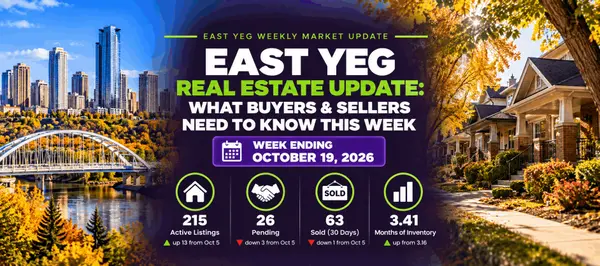





"With 25+ years in Edmonton real estate, I track weekly sales activity across all 13 East YEG neighbourhoods so buyers and sellers get real numbers, not guesswork. If you're weighing a move in East Edmonton, I'm happy to walk you through what the data means for your street."